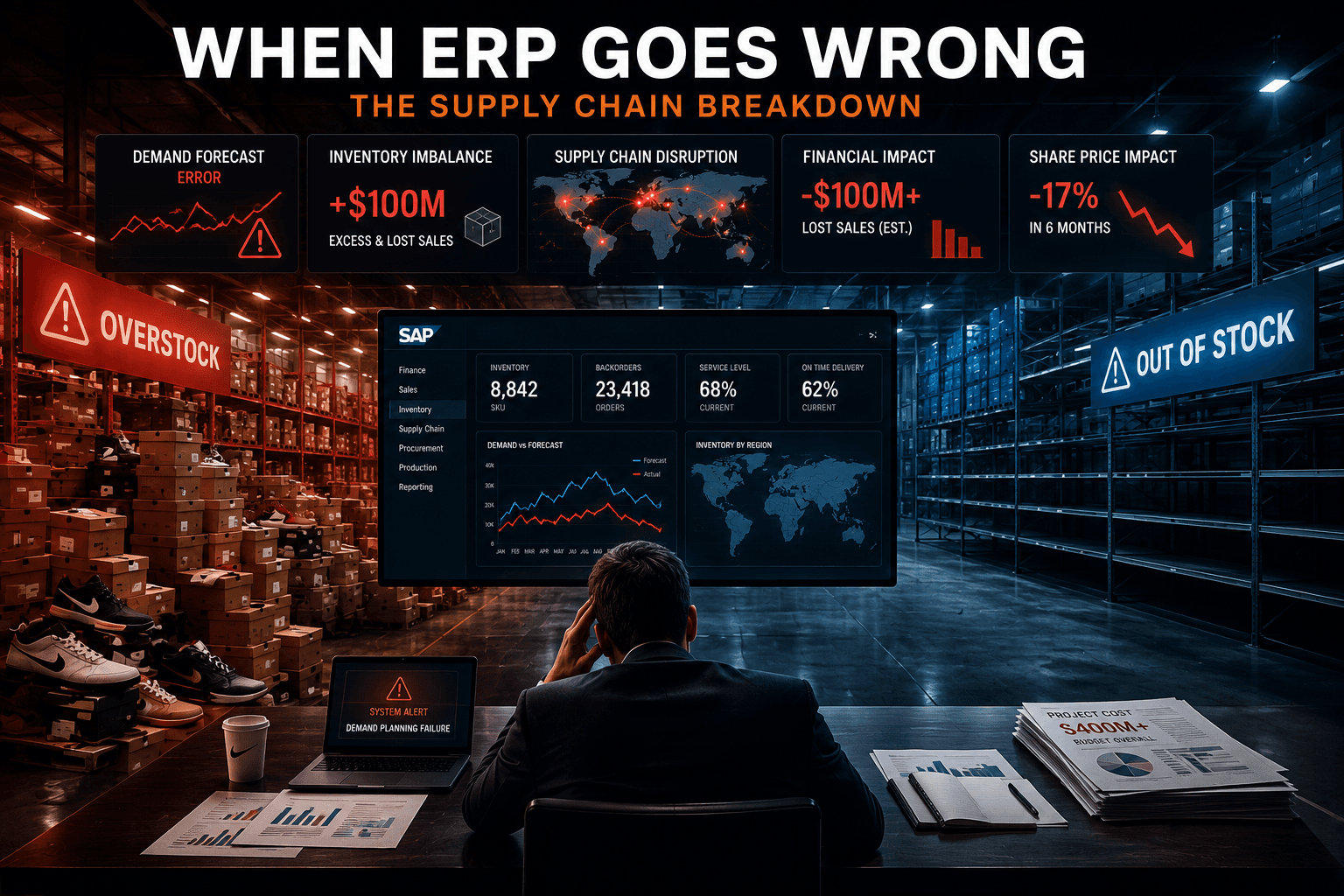
In 2001, Nike lost more than $100 million in sales, saw its share price fall, faced lawsuits from shareholders, and became one of the most famous ERP failure case studies in business history.
The surprising part was that Nike was not a weak company experimenting with unproven technology. It was one of the world's most successful brands. Yet a supply chain software implementation caused disruption across inventory, operations, sales, and customer demand.
The Nike case remains one of the clearest examples of why ERP projects are among the riskiest initiatives an organization can undertake.
Why ERP Projects Are So Risky
ERP is different from normal software. If a website fails, it may become a marketing problem. If an email system fails, it becomes a communication problem. But if an ERP system fails, the entire organization can be affected.
An ERP system functions much like the brain of an organization. It connects departments, coordinates activities, stores information, and supports decision-making. When one area is affected, the consequences can spread throughout the entire business.
The Nike ERP Failure
In the late 1990s and early 2000s, Nike launched a major transformation program involving SAP ERP, Siebel CRM, and i2 Technologies' supply chain planning software. The goal was to create an integrated platform with stronger visibility, forecasting, and operational control.
Instead, the demand planning software generated inaccurate forecasts. Some products were overproduced, while others were unavailable when customers wanted them. Nike reportedly had excess inventory in some product lines while failing to meet demand for others.
- More than $100 million in lost sales
- Major supply chain disruption
- Share price decline
- Shareholder lawsuits
- Additional investment required to stabilize and complete the transformation
Nike Failure Timeline
- 1999: Nike launches a major technology transformation initiative
- 2000: SAP, Siebel, and i2 implementation work begins
- 2001: Inventory forecasting issues emerge
- 2001: More than $100 million in sales impact is reported
- 2001: Share price declines and shareholder lawsuits follow
- 2006: The broader transformation is largely stabilized
Root Causes of the Failure
Many ERP failures are incorrectly blamed only on software. In reality, software is usually only one part of the problem. The deeper issues are often connected to processes, data, governance, timelines, integration, and change management.
- Too much change at once: Nike attempted ERP, CRM, and supply chain transformation simultaneously
- Poor data quality: forecasting systems depend on accurate and consistent data
- Integration challenges: different systems may use different assumptions, definitions, and business rules
- Compressed timelines: business pressure can force unrealistic implementation schedules
- Insufficient risk management: organizations often focus on budget and deadlines while underestimating operational risk
The Value of a Single-Instance ERP System
Despite the early difficulties, Nike remained committed to its long-term vision. A single-instance ERP system means business units operate on the same platform, use the same data definitions, and follow common processes.
- One source of truth across finance, operations, procurement, and supply chain
- Improved visibility into inventory, demand, suppliers, and performance
- Better global coordination across countries and regions
- Reduced duplication and fewer manual data errors
- Stronger reporting, analytics, forecasting, and strategic planning
Nike Was Not Alone
Nike was not the only major company to experience serious enterprise system problems. Hershey faced order fulfillment issues after a complex ERP, supply chain, and CRM rollout in 1999 during a critical business period.
Lidl also became a major ERP failure example after reportedly investing around 500 million euros over several years before abandoning its SAP implementation. These failures show that ERP projects often fail for similar reasons: poor governance, rushed timelines, weak testing, unclear requirements, and organizational resistance to change.
My Perspective
While working on the Saudi Muaythai Federation's digital platform, I have developed a greater appreciation for the complexity of enterprise systems. Although our platform operates in sport rather than retail, the principle remains the same.
Once athlete registration, event management, rankings, certifications, scoring, payments, and governance are connected through a single platform, a mistake in one area can affect the entire ecosystem. The challenge is not usually the technology itself. The challenge is aligning processes, governance, business rules, data structures, and user expectations into one operating model.
Seven Lessons for Organizations
- Treat ERP as a business transformation, not an IT project
- Clean your data before implementation
- Redesign processes before automation
- Invest heavily in user training
- Test real-world business scenarios
- Avoid unnecessary customization
- Roll out in phases whenever possible
Final Thoughts
The Nike case demonstrates that technology rarely causes ERP failures on its own. More often, failures occur when organizations underestimate the complexity of changing people, processes, and data simultaneously.
ERP systems can create tremendous value, but only when supported by strong governance, realistic planning, disciplined execution, and a clear understanding that technology is merely an enabler of business transformation.