My career didn't start with a plan to work in information systems. It started in project management and operations, coordinating people, timelines, and moving parts, and making sure things actually got delivered. But somewhere along the way, a pattern became impossible to ignore: every organization I worked with, no matter how ambitious or well-resourced, was only as strong as the systems running underneath it.
Good strategy died in bad reporting. Great teams were slowed down by disconnected tools. Decisions that should have taken minutes took weeks because the right data lived in the wrong place, or in no place at all. Watching that happen repeatedly is what pulled me toward information systems, not as an abstract academic interest, but as the discipline that actually explains why some organizations move fast and others don't. Somewhere in that shift, digital transformation, automation, enterprise platforms, data, and artificial intelligence stopped being buzzwords I read about and became the things I wanted to spend my career building.
Where I Am Today
Today, my work sits across project management, operations, and strategic planning, and every one of those areas has quietly been teaching me information systems long before I had the title for it.
Managing KPI reporting taught me that a metric is only useful if the system producing it is trustworthy. Handling government initiatives and submissions taught me that accuracy and accountability aren't optional; they're the whole job when you're representing an organization to an external authority. Working directly on website and platform development, rather than simply requesting it from someone else, taught me how a digital product actually gets built, not just how it looks in a slide deck. Leading process improvement work showed me how much friction exists in organizations simply because no one has redesigned the workflow around the tools people actually use. And coordinating international stakeholders across time zones, priorities, and expectations taught me that technology only creates value when the people around it are aligned.
None of these responsibilities look like "information systems" on paper. In practice, they've been the best possible training for it.
- Project Management — delivering initiatives from idea to execution
- Operations Management — keeping complex, moving organizations running
- Strategic Planning — connecting daily execution to long-term direction
- KPI Reporting — turning activity into decision-ready information
- Government Initiatives & Submissions — precision under real accountability
- Digital Systems Implementation — rolling out the platforms teams depend on
- Website & Platform Development — building the product, not just requesting it
- Process Improvement — redesigning workflows, not just tools
- Event Management — executing under pressure and fixed deadlines
- International Stakeholder Coordination — aligning people across priorities and geographies
Why Information Systems Inspires Me
It took me a while to articulate why this field pulls at me the way it does, and it's this: information systems isn't really about software. Software is just the visible layer. Underneath it, information systems is about the relationship between people, business processes, technology, data, and decision making, and how those five things either work together or quietly work against each other.
- People — the ones using, resisting, or championing the system
- Business Processes — the real workflow the system needs to fit
- Technology — the platforms and tools that make execution possible
- Data — the raw material every good decision depends on
- Decision Making — the whole point of the first four coming together
When those five elements are aligned, an organization becomes efficient, scalable, and able to adapt without falling apart. When they're not, you get exactly what I've seen too many times: brilliant people working around broken systems instead of through them. I've never been especially motivated by simply performing tasks. What genuinely excites me is fixing the system so the task barely needs to exist anymore, and that instinct is exactly what drew me here.
The Future I Am Building
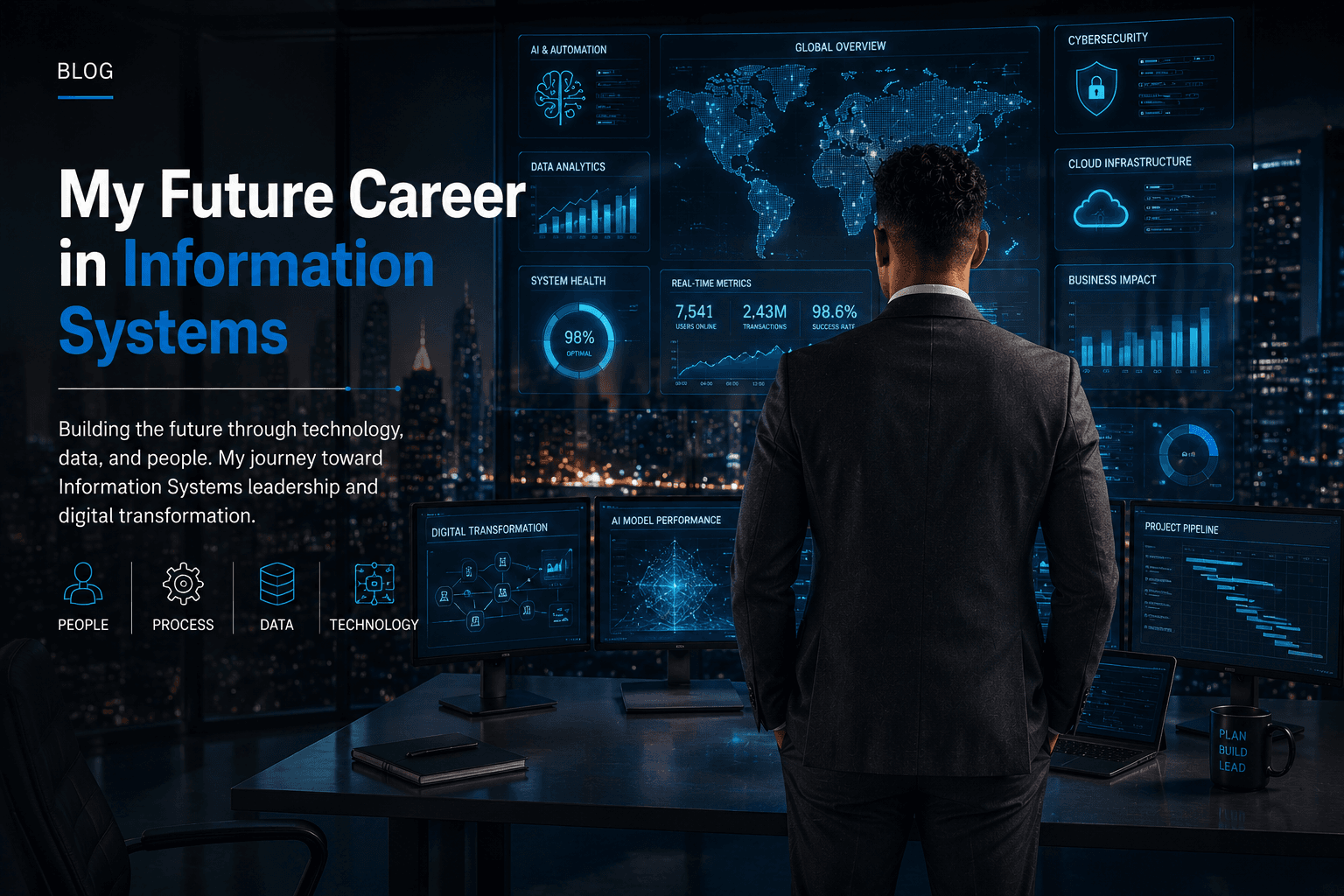
I think about the next five to ten years less as a job title and more as a widening circle of capability. It starts with enterprise systems and the operational backbone I already understand, and expands outward into artificial intelligence, automation, business intelligence, and data analytics, then further still into cloud computing, cybersecurity, enterprise architecture, and software development. Digital transformation sits at the center of all of it, because that's the actual outcome I'm building toward, not any single tool or platform.
- Enterprise Systems
- Artificial Intelligence
- Automation
- Business Intelligence
- Data Analytics
- Cloud Computing
- Cybersecurity
- Digital Transformation
- Enterprise Architecture
- Software Development
Technology in this space doesn't sit still, and I don't want to either. The professionals who stay relevant in the next decade will be the ones who treat learning as a constant, not a phase they finished in university. That's the standard I'm holding myself to.
Skills I Am Developing
I've deliberately avoided narrowing myself to one lane too early. The leadership roles I'm aiming for don't reward someone who is only technical or only strategic, they reward someone fluent in both, which is why I'm building these two skill sets in parallel rather than one after the other.
Technical Skills
- Artificial Intelligence
- SQL & Databases
- Business Intelligence
- Automation
- Cloud Computing
- Cybersecurity
- Software Development
- Enterprise Systems
Professional Skills
- Leadership
- Project Management
- Strategic Planning
- Stakeholder Management
- Communication
- Operations
- Problem Solving
- Continuous Learning
Learning Never Stops
I don't think of certifications as lines to add to a profile. I think of them as structured excuses to go deep on something I'd otherwise only learn on the surface, on the job, under deadline pressure. Each one on my list targets a specific gap between where I am now and where I want to be.
- Microsoft AI — applied artificial intelligence on a platform I already work in
- Microsoft Azure — cloud infrastructure and enterprise-grade deployment
- Google AI — a second, differently-opinionated view of applied AI and data
- PMP — formalizing project leadership at an internationally recognized standard
- ITIL 4 Foundation — IT service management and governance discipline
- CompTIA Security+ — foundational, practical cybersecurity
- CISA — systems assurance, audit, and control at an enterprise level
- Future postgraduate study — going deeper into information systems and digital strategy
In a field that changes this quickly, standing still is the same as falling behind. Certifications are how I make sure I'm still moving.
My Career Roadmap
I see my path less as a checklist and more as a set of stages that each depend on the one before it. Graduating in information systems gives me the formal foundation, the language and frameworks to make sense of what I've already been doing intuitively in operations and project management. That foundation only becomes real once I put it to work gaining practical experience building digital solutions, not just specifying them for someone else to build.
From there, practical experience earns the credibility to lead enterprise technology projects, where the stakes, scale, and stakeholder count all increase. Leading enough of those projects well is what eventually opens the door to managing information systems as a formal responsibility rather than a project-by-project contribution. Managing information systems well, in turn, is the proving ground for leading digital transformation at an organizational level, connecting strategy, data, and technology into a single operating model instead of a collection of separate initiatives.
And leading transformation successfully, again and again, is ultimately what earns a seat at the executive table, whether that's a CIO or Chief Digital Officer role. Each stage isn't a separate ambition. It's the prerequisite for the next one.
- Graduate in Information Systems
- Gain practical experience building digital solutions
- Lead enterprise technology projects
- Manage Information Systems
- Lead Digital Transformation
- Executive technology leadership (CIO / Chief Digital Officer)
A Vision Beyond Technology
None of this is really about technology for its own sake. My ambition is to help organizations become more efficient, more innovative, more secure, and more data-driven, and technology happens to be the most powerful lever available for doing that. But the lever only works if you remember what it's for. Technology should always serve people and business objectives, never the other way around. The moment an organization starts redesigning its people and processes to suit the software instead of the other way around, something has already gone wrong, and I've seen that mistake up close enough times to know I don't want to repeat it.
Final Reflection
Information systems combines almost everything I care about professionally: technology, strategy, leadership, continuous improvement, innovation, and problem solving, all in one discipline. That's rare, and it's exactly why I've stopped seeing this as a career shift and started seeing it as the natural destination of everything I've already been doing.
I believe the future belongs to professionals who can stand comfortably in both worlds, business and technology, who can communicate across that divide instead of retreating to one side of it, who adapt when the tools and expectations change again, and who never quite consider their learning finished. That's the professional I'm building myself into.
This journey is only beginning, and I'm looking forward to every part of it, the challenges included.